
Feed-in tariffs in Victoria have effectively hit zero. The Essential Services Commission set the minimum flat feed-in tariff at just 0.04 cents per kilowatt hour for 2025-26, which means exporting solar to the grid now earns next to nothing. That has left plenty of homeowners wondering whether panels still make financial sense. The short answer is yes for most homes, but the reason has changed: the value of solar panels in 2026 comes almost entirely from using your own generation instead of buying from the grid.
The short answer
- Solar is still worth it for most Melbourne homes — but as a self-consumption asset, not an export earner.
- Every kilowatt hour you use yourself saves the full retail price, which is many times higher than the export rate.
- A battery turns near-worthless exports into evening savings at full retail rates, helped by the federal battery discount.
- Size the system around your actual usage pattern rather than maximising panel count.
Why Are Feed-In Tariffs So Low?
The middle of the day now has more rooftop and large-scale solar generation than the grid needs, so wholesale electricity prices at those hours regularly fall to very low or even negative levels. Feed-in tariffs reflect the wholesale value of the energy at the time it’s exported, which is why the regulated minimum has drifted down year after year and has now reached effectively zero. This is a structural change rather than a temporary dip, so it’s worth planning around it instead of waiting for export payments to recover.
0.04c
Minimum flat feed-in tariff per kWh set for 2025-26
11am–2pm
Free power window under the Midday Power Saver from October 2026
~30%
Federal battery discount on approved batteries as of 2026
Where Does the Value of Solar Come From Now?
From the power you don’t buy. When your panels run the fridge, air conditioning, dishwasher or hot water, you avoid purchasing that electricity at the full retail rate, which in Victoria is many times higher than the export rate. A system that mostly offsets your own consumption still cuts bills meaningfully. A system that mostly exports does very little at current tariffs. This is why, when we design a system for a household, we look closely at usage patterns before deciding on panel count or orientation, rather than defaulting to the largest system a roof can fit.
How Can You Increase Self-Consumption?
Shifting usage into daylight hours is also becoming easier from October 2026, when Victoria’s new Midday Power Saver scheme offers free electricity between 11am and 2pm to households on eligible retail plans, on top of whatever your own panels are already generating.
- Run the dishwasher, washing machine and dryer during the day, on timers if nobody is home
- Heat water in the middle of the day with a heat pump hot water system, which effectively acts as a thermal battery
- Pre-cool or pre-heat the house in the afternoon using efficient heating and cooling, rather than paying grid prices in the evening peak
- Charge an EV from the solar during the day where the household routine allows
- Store the remaining excess in a home battery for the evening
Most households can lift self-consumption noticeably with timers and habit changes alone, before spending anything on storage.
Does a Battery Change the Equation?
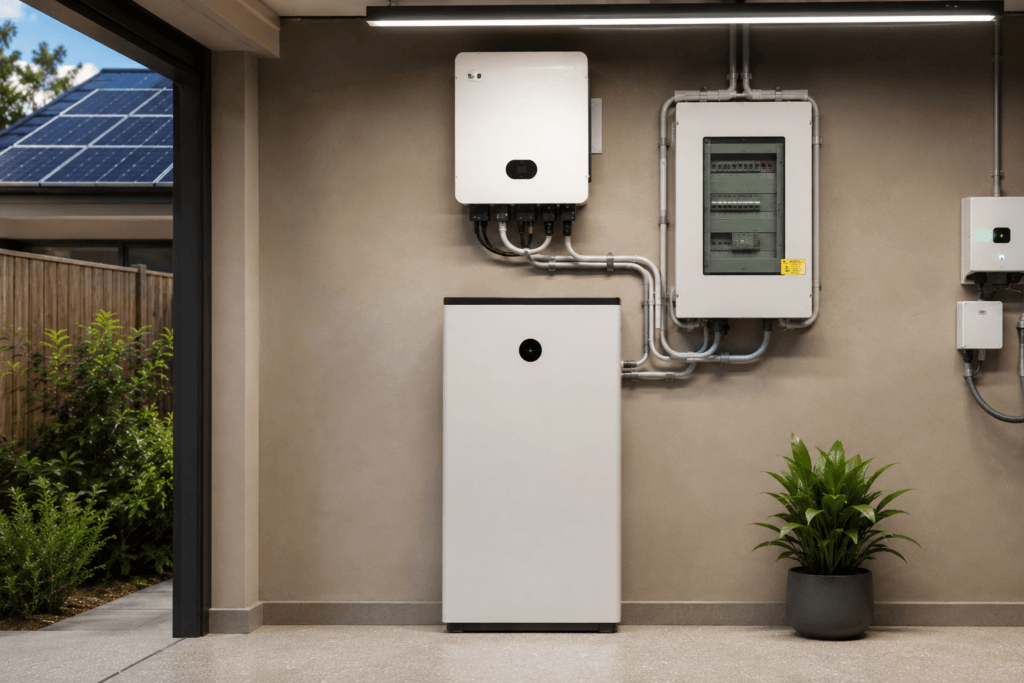
Significantly. A home battery takes the midday excess that would otherwise earn nothing and delivers it back in the evening, when grid power is at its most expensive. The federal Cheaper Home Batteries program, introduced in July 2025, reduces the upfront battery cost by around 30 per cent as of 2026, which has shortened payback times for solar and battery combinations. For a home that’s currently exporting a lot, a correctly sized battery turns near-worthless exports into full retail-rate savings.
When Solar Clearly Still Makes Sense
Solar remains a strong investment if someone is home during the day, if you run air conditioning through summer, if you have or plan to get an EV, or if you’re electrifying gas appliances such as hot water and heating. High daytime usage means most generation is consumed on the spot, and the low feed-in tariff barely matters.
When It Might Be Worth Waiting
If the house is empty all day, evening usage is modest, the roof is heavily shaded, or you plan to move within a couple of years, the case is weaker without a battery in the design. In those situations, it’s worth getting solar and storage quoted together and comparing the numbers honestly, rather than installing panels alone and exporting most of the output for nothing.
So Is Solar Still Worth It in 2026?
For most Melbourne homes, yes — but as a self-consumption asset rather than an export earner. Size the system to your actual usage pattern instead of maximising panel count, shift flexible loads into daylight hours, and treat a battery as part of the conversation from day one. If your daytime usage is genuinely low and storage is out of budget, it’s worth getting the numbers checked before committing.
Read more: What Does Solar Actually Cost in Melbourne After Rebates in 2026?
Get your solar numbers checked
Our team at Axial Electric has spent over 15 years designing solar and battery systems around real household usage data rather than just available roof space, and we can quote solar and storage together so the two options are easy to compare.
Frequently Asked Questions
What is the minimum feed-in tariff in Victoria right now?
The Essential Services Commission set the minimum flat feed-in tariff at 0.04 cents per kilowatt hour for 2025-26, which is effectively zero. Some retailers offer slightly higher or time-varying rates, but exports no longer contribute meaningfully to solar returns.
Should I install a smaller system now that exports earn nothing?
Not necessarily. If a battery, EV, or electrified hot water and heating are in your plans, the extra capacity gets used rather than exported. Undersizing now can mean paying for an upgrade later.
Is solar worth it without a battery?
For many homes, yes. If a reasonable share of your usage happens during daylight hours, the savings from self-consumption alone can justify the system. The weaker the daytime usage, the stronger the case for pairing it with storage.
Do Melbourne winters undermine the numbers?
Winter output is lower, but generation across the year remains substantial, and summer production in Melbourne is strong. Systems are assessed on annual performance, and self-consumption value applies in every season.
Is there still a solar panel rebate in Victoria?
Yes. As of 2026, Solar Victoria offers a panel rebate of up to $1,400 for eligible households, alongside federal small-scale certificates that reduce upfront cost. Eligibility criteria apply, so check Solar Victoria’s current requirements before purchasing.