
If you own an electric vehicle in Victoria, you’ve probably heard about government rebates. The reality is simpler, and often less generous, than you might expect. Most dedicated EV rebates have ended but there are still a few real options, and some work much better than others.
The short answer
- Direct EV rebates are gone — the $3,000 purchase rebate ended June 2023 and the $100 rego discount ended January 2026.
- Stamp duty is still your best direct saving — 0% on BEVs valued under $68,740.
- There’s no rebate for home EV chargers — budget for it yourself.
- The real money is in solar + battery and the new Midday Power Saver free-power window.
Direct EV Rebates That Have Ended
Victoria’s electric vehicle purchase rebate ended on 30 June 2023. That program paid up to $3,000 at the point of sale for vehicles valued under $68,740. If you’re buying an EV now, this rebate no longer exists.
The annual $100 registration discount for EV owners ended on 1 January 2026. This was a modest saving on your registration renewal each year, but it no longer applies.
No rebate exists for home EV chargers in Victoria. Past programs that supported home charger installation have closed. This leaves the cost of installing a Level 2 home charger on your own budget — typically $500 to $2,000 for equipment plus installation.
What You Can Actually Claim
0%
Stamp duty on battery EVs under $68,740
$1,400
Solar Homes rebate for panels, plus up to $1,400 for a battery
$1,070
Per year saved charging in the Midday Power Saver window
The stamp duty concession is the strongest direct benefit remaining. Battery electric vehicles with a taxable value under $68,740 qualify for zero percent stamp duty in Victoria. Most affordable EVs, including models like the MG4, BYD Atto 3, and Chery E5, fall below this threshold. This can save you thousands at purchase.
Federal fringe benefits tax exemption applies to EVs under the luxury car tax threshold of $91,387. If you’re considering a vehicle through salary sacrificing, this is worth checking with your accountant or employer.
Charging Your EV with Solar Is the Real Opportunity
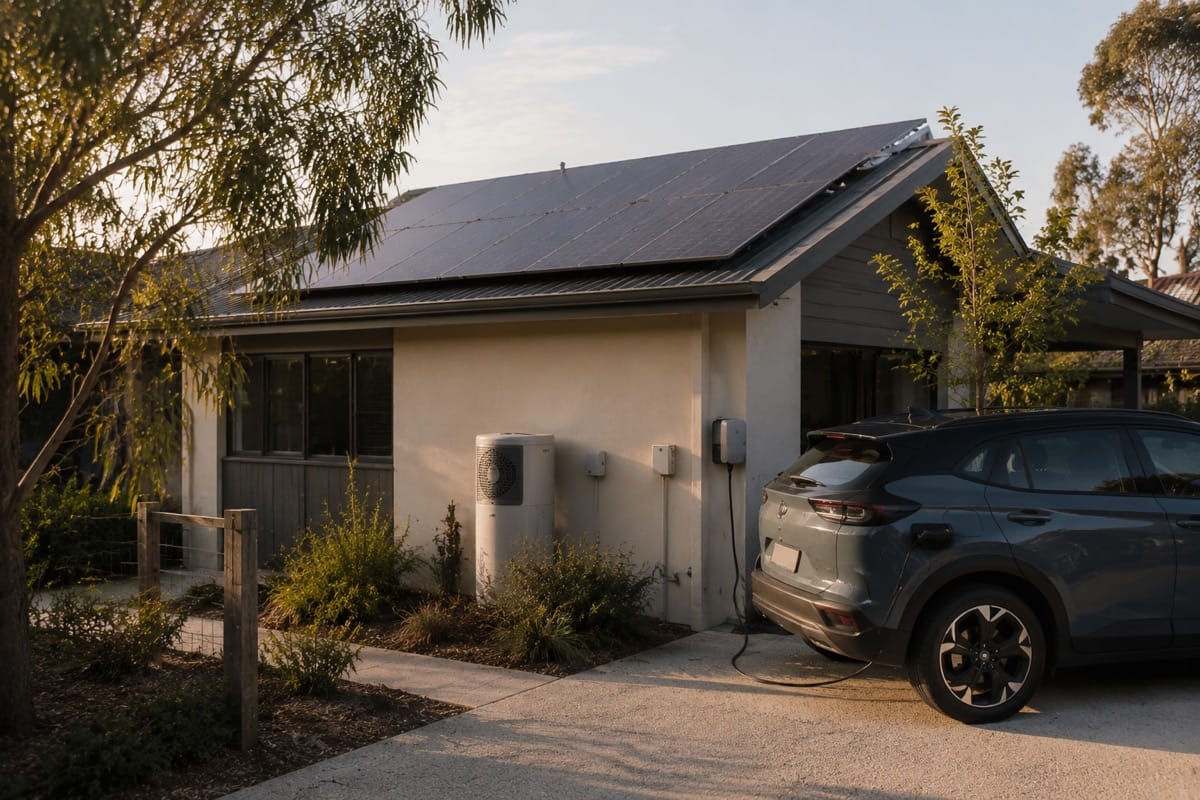
This is where EV owners in Victoria find real financial benefit. The Solar Homes program offers rebates up to $1,400 for solar panels and up to $1,400 for battery storage. If you install solar panels and charge your EV during daylight hours, you can eliminate the grid electricity cost of charging.
Pairing solar with an EV works practically. Most EVs charge at night, but a home battery system lets you store solar energy generated during the day and use it to charge after dark. A 5-kilowatt solar system can generate enough to charge a typical EV and cover your household electricity needs, depending on your driving patterns and consumption.
To access the Solar Homes program rebates, your combined household income must be $150,000 or less per year (as of 1 July 2026). You must meet this threshold to be eligible.
Solar, Not Chargers, Is Where the Support Is
Victoria’s government focus in the Residential Electrification Grants programs is on solar, heat pumps, and hot water systems. EV chargers are not included in these rebates. If you want government support for your EV charging costs, the indirect route through solar is your best option.
Heat pump hot water systems also receive rebates up to $1,400 through the Solar Homes program. Combining solar, battery, heat pump hot water, and an EV charger creates a fully electrified home — but you will pay the charger installation cost directly.
For the full picture, see which Victorian energy rebates you can currently claim as a homeowner.
What About Federal Support?
There is no current federal rebate for EV buyers or charger installation in Australia. Any federal support is broader — focused on energy efficiency or renewable energy, rather than specific to electric vehicles.
Check Your Local Council
Some local councils in Victoria offer additional rebate information or rebates for energy efficiency upgrades. It’s worth checking your local council’s website to see if they manage public energy programs or can direct you to relevant support. These vary significantly by area and are not guaranteed.
Reducing Your EV Charging Costs with Midday Power Saver
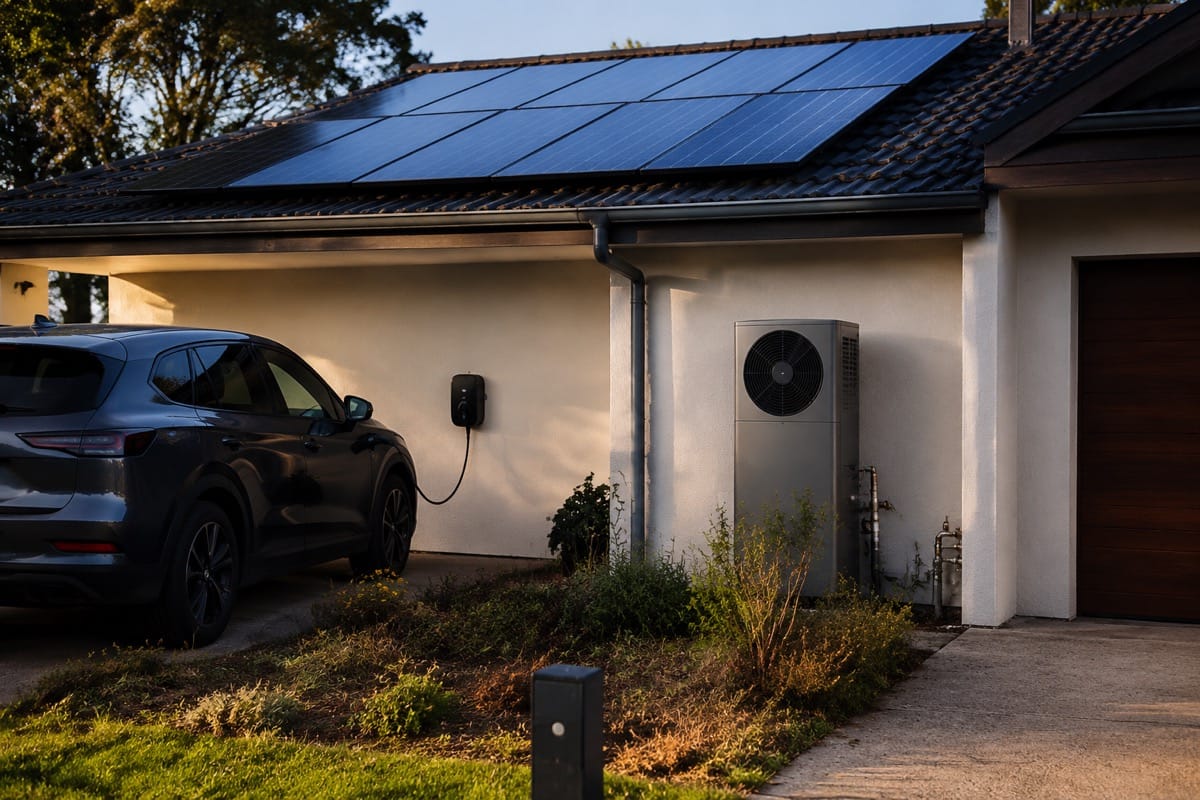
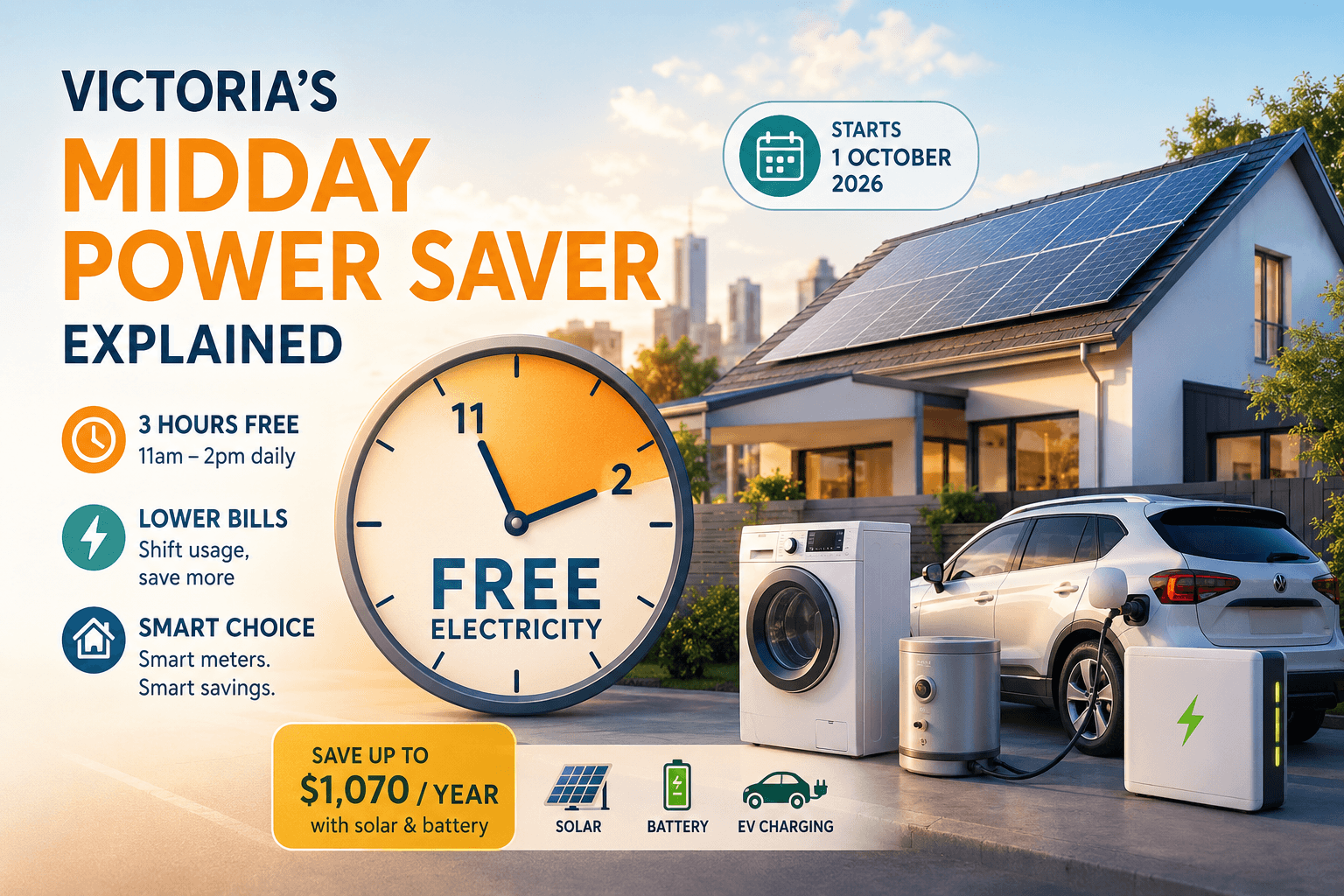
Although no direct rebate exists for charger installation, Victoria’s new program offers a real opportunity to reduce EV operating costs. From 1 October 2026, most Victorian households can access free electricity between 11am and 2pm through the Midday Power Saver program.
This means you can schedule your EV charger to operate during these three free hours every day. For details on EV charger types and sizing that work best with the Midday Power Saver, our team can help you choose the right system.
Households with battery storage systems and solar panels can save up to $1,070 per year by running their EV charger during the free period. Even without solar, EV owners who work from home or have flexible schedules can save $149 to $300 per year by shifting usage to the midday window.
For complete details about how this program works and how much you can save, read Victoria’s Midday Power Saver Explained.
The Honest Summary
Victorian EV owners have stamp duty savings and possible federal fringe benefits tax advantages. But if you’re looking for cash rebates to offset charger installation or operating costs, most of those have disappeared. Real financial benefit comes from pairing your EV with a solar system and battery. This approach reduces both your charging costs and your overall electricity bills. On top of that, the Midday Power Saver program provides an additional opportunity to save by scheduling charging during free hours.
Install a charger as a genuine decision based on your driving needs and your home’s electrical capacity — not because you expect government support. For a reliable installed Level 2 charger, budget $2,000 to $3,500. If your home and finances support it, calculate the solar option separately.
Get realistic advice for your home
Doing this correctly depends on your switchboard capacity, your driving habits, and whether solar makes sense for your situation. Axial Electric works across Melbourne and the surrounding areas — including Lynbrook, Cranbourne, Berwick, and Narre Warren — with a Victorian Electrical Licence and 15+ years designing electrification solutions for Victorian homes.
Frequently Asked Questions
What is the difference between Level 1, Level 2, and Level 3 chargers?
Level 1 uses a standard 10-amp household outlet and charges slowly, adding about 3 to 5 kilometres of range per hour. Level 2 is a dedicated wall charger on a 32-amp circuit, delivering 6 to 8 kilometres of range per hour and a full charge overnight. Level 3 is DC fast charging at public networks, adding hundreds of kilometres in 20 to 30 minutes. Most home installations are Level 2.
Can I charge my EV with a standard power outlet?
Yes, but it’s very slow. A mobile cable on a standard outlet delivers Level 1 charging. It works for occasional top-ups or if you’re rarely in a hurry, but most EV owners with regular driving needs install a Level 2 charger for practical overnight charging.
Does my home’s switchboard have enough capacity for a 7-kilowatt charger?
It depends on your current electrical load and whether your home has a single-phase or three-phase connection. Older homes with limited capacity may need switchboard upgrades. An electrician can assess your supply in just a few minutes. Budget additional costs if an upgrade is needed.
If I charge during off-peak hours, how much does it cost?
Off-peak rates vary by network and retailer but typically cost 10 to 20 cents per kilowatt-hour, compared to 25 to 35 cents during peak hours. An EV using 20 kilowatt-hours for a full charge costs $2 to $4 off-peak, compared to $5 to $7 during peak. Checking your retailer’s time-of-use tariffs is worth considering.
Will my EV road user charge come back?
No. Victoria’s EV road user charge (2.5 cents per kilometre) was ruled unconstitutional by the High Court in October 2023 and abolished. There is no indication it will return. At the federal level, road user charges have been discussed but no policy exists.
What is the best EV charger brand for home installation?
Reliable brands include Tesla Wall Connector, Zappi, WallBox, and JET Charge. Avoid the cheapest options — a quality charger will last 10 years or more with few issues. Your electrician can recommend what’s suitable for your vehicle and home setup.